Share this article
The Utter Unimportance Of Everything That Is Not Love*

When is the last time you asked the most important question you could ask yourself: 'What am I investing my life in?'
Speaking to pilgrims gathered in St. Peter's Square on Nov. 14, 2021, the late Pope Francis urged people to reflect on whether their time is spent on things that are transitory or on the ultimate things that remain:
'Brothers and sisters, let us ask ourselves: what are we investing our lives in? On things that pass, such as money, success, appearance, physical well-being? … When our time comes ... we have to leave everything behind,' the pope reminded everybody, before adding: 'The Word of God warns us today: This world will pass away, and only love will remain.'
Even when we know what the pope says is true, many of us continue to act as if it isn't. Then, before we know it, we could be at the end of our days on earth. Picture, if only for a moment, how you'd feel on your deathbed if you finally became aware that you had spent most of your existence living for yourself and chasing what the world had taught you was necessary for a happy life: money, success, your appearance, and so on. Now you're going to leave it all behind. It happens all the time. It almost happened to me:
After leaving college, I hadn't a clue what life was about, but I had bags of energy. I took a job as a secondary school teacher, but I knew from the beginning it was just a stopgap. The world was my oyster, and I dreamt of 'bigger things':
Despite being clueless about commerce, I set up a business. My main motivation was to become financially independent and travel the world in style. The problem was that it didn't work out like that. No one I met, not even business people, had talked about how really hard it was to run your own company. The media mostly hyped the rewards: a luxury lifestyle, freedom and flexibility, wealth, and so on. However, like most entrepreneurs, I inevitably got caught in a spider's web of financial insecurity, long hours, and the tricksters I met along the way.
Luckily, in my mid-twenties, I met my late wife, Cushla. Foolhardy as I was, I intuited early on that she was incredibly wise. Indeed, she seemed not to be of this world. So after only a few weeks of knowing her, I asked her what she thought life was all about. I knew she would give me a simple but profound answer. 'Love', she said without missing a beat. It wasn't some romantic notion she read or saw in the movies. Instead, as I was to learn more over the years, it was one of her mystical knowings, a higher form of knowledge, she drew from deep within her soul.
Despite intellectually understanding Cushlas's answer, I set the notion aside and continued, undeterred, in my ambition to succeed. But, years later, when my business finally began to do well, I felt an awful emptiness.' 'Is this it?' I asked myself, more than once.
One night in bed, I felt restless, so I got up and went to the guest room to avoid disturbing Cushla's sleep. As I lay awake, I was experiencing what I called my 'empty desert feeling'. The feeling manifested mainly on weekends and other times when I was off work. I wasn't as distracted then, and so the emptiness would come to the surface. At the time, I wasn't aware of the reasons, but I now understand it was due to my duality — not prioritising God, my spiritual well-being, and the only eternal treasure: love.
As I lay on my back, staring at the ceiling, I prayed to God to help me find a more meaningful purpose in my life and to take away this emptiness. I was even willing to give up my business interests to fill this void. However, I tried my best not to bargain with Him. With all the sincerity I could muster, I said to Him: 'You can take away my business. I know subconsciously I'm probably saying this to get something back. With this awareness in mind, I offer my prayer to you anyway, and you don't have to give me something back in return.'
When I said this, the bedroom suddenly lit up with a dark, reddish colour. I thought it could be the presence of the Sacred Heart, but I wasn't sure. Nevertheless, I was given a profound grace. At that moment, I sensed an inner knowing that everything was okay in a profoundly spiritual sense. 'All shall be well, and all shall be well, and all manner of things shall be well,' the revelation that the English mystic Julian of Norwich received from God, provides the closest account I have read of the supernatural phenomenon I experienced.
Cramped souls living in a small world

'Do you know what hurts so very much? It's love. Love is the strongest force in the world, and when it is blocked, that means pain.'
—Casper Ten Boom's advice to his daughter Corrie** (from her memoir, The Hiding Place)
After the experience when the bedroom lit up red, I paid more attention to my spiritual life and tried much harder to prioritise love. I realised that ambition had narrowed my vision, and sometimes I didn't really see people.
In his commencement address given at the University of St. Thomas in Houston on May 8, 2021, Bishop Robert Barron talked to the students about ‘Stretching Out to Great Things’:
‘If we define our own values, our own truth, our own purpose, we effectively lock ourselves into the tiny space of what we can imagine or control. When we follow these prompts of our culture today, we become cramped souls, what the medieval philosophers called pusillae animae. The entire point of a Catholic intellectual formation is to produce magnae animae (great souls). A great soul doesn’t invent her own values; rather, she intuits the marvellous intellectual, moral, and aesthetic values that are found in the objective order—and then she responds to them with her whole heart. She thereby expands in a manner commensurate with the goods that have captivated her.’
One of the prompts of our culture is expressed in the saying: 'I'm free to do what I want as long as I'm not hurting others. This view of morality is so popular that it is assumed every intelligent person agrees with it without realising how narrow their vision is.
Thomas Merton, the American Trappist monk, author and mystic, talks about how, in practice, this theory is shown to be a fallacy in his autobiography, The Seven Story Mountain:
'I believed in the beautiful myth about having a good time so long as it does not hurt anybody else. You cannot live for your own pleasure and your own convenience without inevitably hurting and injuring the feelings and the interests of practically everybody you meet.' He continues with even more unfashionable directness: 'As a matter of fact, in the natural order, no matter what ideals may be theoretically possible, most people more or less live for themselves and for their own interests and pleasure.'
Love is everything, but it's hard work

'In any moment, on any given day, I can measure my wellness by this question: Is my attention on loving, or is my attention on who isn't loving me?'
—Andrea Gibson (1975 - 2025). American poet and activist.
If we could only see how living for our own interests and pleasure leads to so much unhappiness and lovelessness. But there's hope for anybody willing to learn. In his book Wisdom from the Christian Mystics, David Torkington throws light on the matter:
'It has always been believed that happiness depends on love more than on anything else. The greater the love, the greater the happiness. Yet for some unaccountable reason, it does not always occur to people that, like everything else that is worth achieving, loving must be learnt. Far from being an exception to the rule, learning to love is more difficult than anything else, because human beings are insatiably selfish and learning to love means learning to be selfless.'
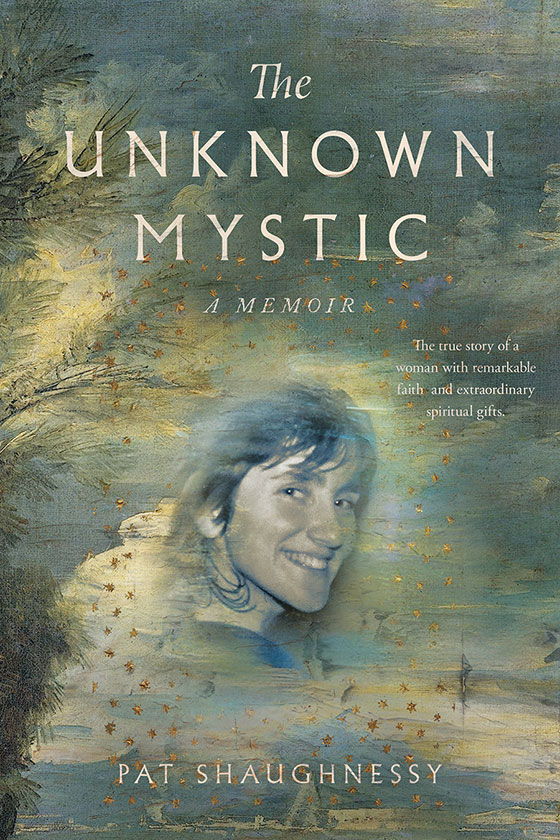
David Torkington is entirely correct. I saw for myself the results of applying the essential lesson he is talking about. I've said before on this site that Cushla was the happiest person I have ever known. It was no accident— she was also the most selfless person I ever met. Despite her heavy crosses, including bearing a debilitating illness for seventeen years, she put others first. As a mystic, she saw more than most the ultimate reality that we are all connected. She wasn't famous or recognised by the world, but she succeeded at what counted: she loved immeasurably.
Notes:
*Jesus speaking to Gabrielle Bossis (1874-1950), a Catholic Mystic. From her book, He and I.
**Read my article on Corrie Ten Boom here: The Watchmaker's Daughter
Share this article
Categories
in your inbox

Inspirational Lives